|
|
|
|
|
Location
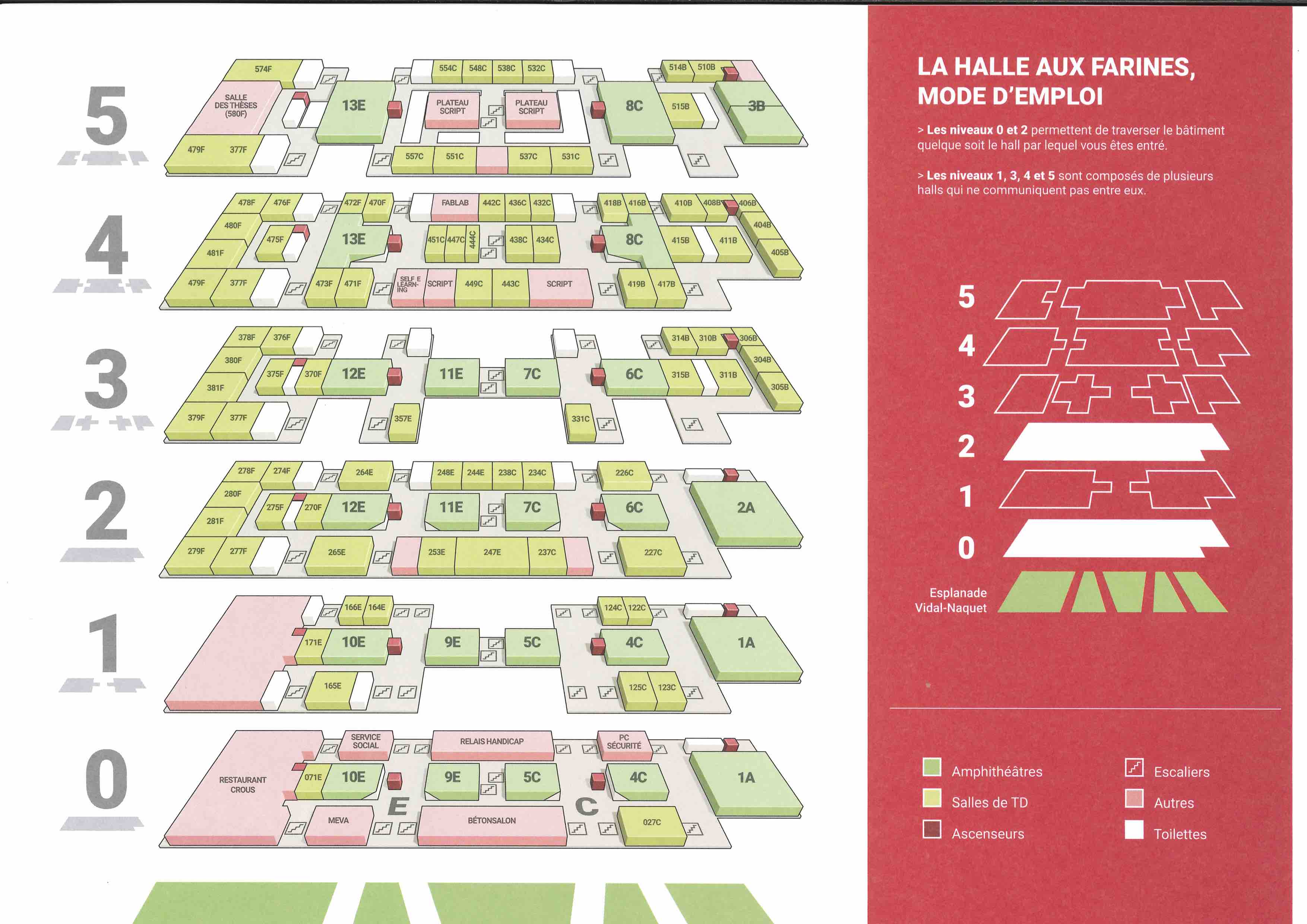
MFCS 2026 will be held in Paris, France, in the building "Halles aux Farines" in the campus des Grands Moulins of the University of Paris, in the 13th arrondissement. The campus is located near the Bibliothèque François Mitterrand, and is easily accessible by public transportation.
A map of the building can be found here.
Talks happen in amphitheater 1A and 4C.
Rooms 123C, 125C, and 027C can also be used by the participants for working.
Schedule
Sunday, 13h00-21h00: Young Researcher's Forum
The forum’s aim is to offer an opportunity for young researchers (master’s students, PhD candidates and postdocs) to meet, to discuss, as well as to engage with more experienced researchers on different aspects of scientific research and career.
- 13h-13h30 Presentations
- 13h30-14h
The work of a Program Committee
- Daniela Petrișan
- 14h30-15h00
An introduction to standards and the standardisation process, or lost and confused at IETF
- Juliusz Chroboczek
- 15h30-16h
Research and Curiosity
- Michal Koucký
- 16h30-17h30
Panel Discussion
- Daniela Petrișan, Tatiana Starikovskaya, Ryan Williams
- 18h00
Game evening and dinner at the board game café Playin (map).
Monday, 9h00-10h05 in 1A: Invited speaker 1
- 9h00 Welcome words
-
- 9h05 Homotopy theory in complexity of the graph homomorphism problem
- Jakub Opršal [+]
Abstract: I will talk about an emerging new application of homotopy theory in computational complexity of combinatorial problems, more precisely *homomorphism problems*. Homomorphism problems appear under many names, including *constraint satisfaction problems* and conjunctive database queries.
A prime example of a homomorphism problem is graph colouring; by a colouring of a graph with *k* colours, I mean an assignment of colours to vertices under which no edge is monochromatic—this is equivalent to the existence of a homomorphism to the clique with *k* vertices. Graph 3-colouring is a prototypical example of an NP-complete problem.
There are many variations on this problem whose complexity remains widely open. For example, although it is generally believed that colouring a 3-colourable graph with a fixed number of colours is NP-hard, only the hardness of colouring of such a graph with 5 colours is known (and shown only in 2019).
I will give an overview of several related results about variations of graph colouring that share a common theme of using a method based on tools from topological combinatorics and on ideas of Lovász [J. Comb. Theory, Ser. A, 25(3):319-324, 1978].
Monday, 10h30-12h10 in 1A: Discrete algorithms
- 10h30 Finding Shortest Reconfiguration Sequence on Independent Set Polytopes
- Takahiro Suzuki, Jean Cardinal, Kevin Mann, Akira Suzuki, Yuma Tamura, and Xiao Zhou
- 10h55 The Complexity of Edge-Induced Greedy Subgraph Building Algorithms within P
- Zohair Raza Hassan, and Edith Hemaspaandra
- 11h20 Sharp Thresholds for Temporal Motifs and Doubling Time in Random Temporal Graphs
- Henry Austin, George B. Mertzios, and Paul Spirakis
- 11h45 Separating Feasibility and Movement in Solution Discovery: The Case of Path Discovery
- Hanno von Bergen, Larissa Fastenau, Enna Gerhard, Nicola Lorenz, Stephanie Maaz, Amer Mouawad, Roman Rabinovich, Nicole Schirrmacher, Daniel Schmand, Sebastian Siebertz, and Mai Trinh
Monday, 10h30-12h10 in 4C: CSP and models of computation
- 10h30 When Darwin met Ianus: dichotomies of expressivity
- Moritz Schöbi, Johanna Brunar, and Michael Pinsker
- 10h55 The Polynomial Hierarchy and ωω-categorical CSPs
- Santiago Guzmán Pro, and Jakub Rydval
- 11h20 Primitive Recursion without Composition: Dynamical Characterizations, from Neural Networks to Polynomial ODEs
- Olivier Bournez
Monday, 14h00-15h40 in 1A: Computational complexity
- 14h00 Complexity of Clique-Guarded First-Order Logic with Counting
- Steffen van Bergerem, Johannes Friedrich Lange, and Nicole Schweikardt
- 14h25 On the Complexity of Locally Dense Lattices
- Shuichi Hirahara, and Kazuki Ogitsuka
- 14h50 The Power of Small Symmetries
- Nikita Gaevoy
- 15h15 Sublinear Time Algorithms for Abelian Group Property Testing
- Nader Bshouty
Monday, 14h00-15h40 in 4C: Fixed-parameter tractability
- 14h00 Parameterized Complexity of Efficient Sortation
- Robert Ganian, Hung Hoang, and Simon Wietheger
- 14h25 Finding b-colorings Using Feedback Edges
- Jakub Balabán
- 14h50 Counting Equitable kk-Colorings in Graphs of Bounded Clique-width
- Holger Dell, Thore Husfeldt, and Amir Nikabadi
- 15h15 On the Parameterized Complexity of Bounded-Density Vertex Deletion
- Jakob Raupach, Tom-Lukas Breitkopf, Anton Herrmann, and André Nichterlein
Monday, 16h10-17h25 in 1A: Computational geometry
- 16h10 Counting All Lattice Rectangles in the Square Grid in Near-Linear Time
- Dmitry Babichev, and Sergey Babichev
- 16h35 Freeze-Tag with Return
- Nicolas Bonichon, Cyril Gavoille, Nicolas Hanusse, Gabriel Le Bouder, Taïssir Marcé, and Nils Morawietz
- 17h00 Segment Watchman Routes
- Anna Brötzner, Omrit Filtser, Bengt J. Nilsson, Christian Rieck, and Christiane Schmidt
Monday, 16h10-17h25 in 4C: Rewriting, logic and categories
- 16h10 Functorial Semantics for First-Order Theories
- Filippo Bonchi, Alessandro Di Giorgio, Roberto Di Virgilio, and Pawel Sobocinski
- 16h35 Hypergraphs for Compact Closed Categories
- Alessandro Di Giorgio, and Callum Reader
- 17h00 Quantitative equational rewriting
- Besik Dundua, Georg Ehling, Santiago Escobar, Maribel Fernandez, and Temur Kutsia
Monday, 18h30 in La Felicità, 5 Parv. Alan Turing, 75013 Paris (meet at 18:00 at the esplanade next to the conference venue): Cocktail party
Tuesday, 9h00-10h00 in 1A: Invited speaker 2
- 9h00 Highly-efficient local proofs and codes
- Noga Ron-Zewi [+]
Abstract: Interactive oracle proofs (IOPs) extend the classical notion of probabilistically-checkable proofs (PCPs) by allowing a verifier to interact with a prover over a small number of rounds, while querying the prover’s messages in only a few locations.
A recent line of work gave highly-efficient IOPs outperforming state-of-the-art PCPs, for example, constant-round and constant-query (ZK-)IOPs with only a linear (and even approaching the witness length) amount of communication, as well as (ZK-)IOPs with linear-time prover complexity. These constructions were leveraged in turn to obtain highly-efficient succinct arguments and zero-knowledge proofs.
The improved efficiency was obtained by replacing polynomial-based codes, commonly used in such proof systems, with more efficient (tensor-based) codes. In particular, these constructions bypassed a barrier imposed by the need to encode the computation using a multiplication code.
In the talk I will survey these highly-efficient IOP constructions, and highlight some interesting open problems raised by these works.
Tuesday, 10h30-12h10 in 1A: Computational complexity
- 10h30 Monotone Bounded Depth Formula Complexity of Graph Homomorphism Polynomials
- Balagopal Komarath, and Rohit Narayanan
- 10h55 The Descriptive Complexity of Relation Modification Problems
- Florian Chudigiewitsch, Marlene Gründel, Christian Komusiewicz, Nils Morawietz, and Till Tantau
- 11h20 Randomized and quantum approximate matrix multiplication
- Simon Apers, Arjan Cornelissen, and Samson Wang
- 11h45 Nearly Tight Bounds on the Block Number of Boolean Functions in Terms of Sensitivity
- Sourav Chakraborty, and Anna Gal
Tuesday, 10h30-12h10 in 4C: Fixed-parameter tractability
- 10h30 A Dividing Line for Structural Kernelization of Component Order Connectivity via Distance to Bounded Pathwidth
- Jakob Greilhuber, and Roohani Sharma
- 10h55 Increasing arc-connectivity by bounded- and fixed-size inversions
- Lucas Picasarri-Arrieta, and Florian Hörsch
- 11h20 Connectivity Augmentation of Plane Graphs
- Krishnan Dehaleesan, Asif Khan, and Pranabendu Misra
- 11h45 A Congestion Parameter for Depth-First Graph Traversals
- Codaline Bourotte, Gwendal Ducloz, Pekka Orponen, and Shinnosuke Seki
Tuesday, 14h00-15h40 in 1A: Quantum interactive protocols
- 14h00 Multi-Prover Interactive Proof Systems with Leakage
- Vahid R. Asadi, Atsuya Hasegawa, and Francois Le Gall
- 14h25 En Route to a Standard QMA1 vs. QCMA Oracle Separation
- David Miloschewsky, Supartha Podder, and Dorian Rudolph
- 14h50 Towards a universal gateset for $QMA_1$
- Dorian Rudolph
- 15h15 A slightly improved upper bound for quantum statistical zero-knowledge
- Yupan Liu, François Le Gall, and Qisheng Wang
Tuesday, 14h00-15h40 in 4C: Automata and formal languages
- 14h00 On the size complexity of two-way finite automata with drop-once pebbles
- Georgy Kipriyanov, and Alexander Okhotin
- 14h25 Constant-Time Dynamic Enumeration of Word Infixes in a Regular Language
- Antoine Amarilli, Sven Dziadek, and Luc Segoufin
- 14h50 Hamming distance between finite transducers
- Silvio Vescovo, Luc Dartois, Ismaël Jecker, and Pierre-Cyrille Héam
- 15h15 Distinguishing elements in semigroups
- Markus Lohrey, Alexander Thumm, and Julio Xochitemol
Tuesday, 16h10-17h25 in 1A: Algebraic circuits
- 16h10 Satisfiability of multivalued circuits with lists
- Paweł M. Idziak, Piotr Kawałek, Jacek Krzaczkowski, and Armin Weiß
- 16h35 On $CC^0$ Lower Bounds for AND via Torus Polynomials
- Vaibhav Krishan, and Jayalal Sarma
- 17h00 On the Tension Between Full-Rankness and Self-Reducibility for Set-Multilinear Polynomials
- Deepanshu Kush
Tuesday, 16h10-17h25 in 4C: Proof theory and lambda calculus
- 16h10 Bilateralism with incompatible proofs and refutations
- Victor Barroso-Nascimento, Maria Osório, and Elaine Pimentel
- 16h35 On Jumps, Interactions, and Intersection Types
- Stefano Catozi, Ugo Dal Lago, and Gabriele Vanoni
- 17h00 Compression for Coinductive Rewriting and the Cut-Elimination of Non-Wellfounded Proofs
- Rémy Cerda, and Alexis Saurin
Wednesday, 9h00-10h00 in 1A: Invited speaker 3
- 9h00 Some Recent Developments in Space Complexity
- Ryan Williams [+]
Abstract: Given a function, what is the minimal memory necessary to compute it? We will describe old and new algorithmic developments that give surprisingly low-space solutions to this question in many cases. We will survey the recent proof that TIME[t] is in SPACE[sqrt{t log t}] for the multitape Turing machine model, and the engine that makes the proof possible: the amazing Cook-Mertz algorithm for a problem called Tree Evaluation. We will also briefly outline some new developments and generalizations that we've recently proved, pushing the low-space frontier beyond multitape Turing machines.
Wednesday, 10h30-12h10 in 1A: Algorithms
- 10h30 On Positivity of Exponential-Trigonometric Polynomials and Irrationality Exponents
- Pieter Collins, Bernard Hanzon, and Eike Neumann
- 10h55 Smallest suffixient set maintenance in near-real-time
- Dominik Koeppl, and Gregory Kucherov
- 11h20 Exact Cut Complexity of Equal-Length Proportional Cake Cutting
- Yasushi Kawase, and Mohammad Azharuddin Sanpui
- 11h45 How Long Can the Escaping Ant Be Confined?
- Kossi Roland Etse
Wednesday, 10h30-12h10 in 4C: Graphs
- 10h30 Beating Trivial Time For Tricky Triangle Tasks
- Neha Pant, and Ryan Williams
- 10h55 Generalized snarks, disjoint perfect matchings, and graph covers
- Filip Filipi, Jan Kratochvil, and Roman Nedela
- 11h20 A Near-Linear-Time Algorithm for Finding a Well-Spread Perfect Matching in Bridgeless Cubic Graphs
- Babak Ghanbari, and Robert Šámal
- 11h45 Upper Clique Transversal on Interval Graphs and Beyond
- Lars Jaffke, Paloma T. de Lima, and Amir Nikabadi
Wednesday, 14h00-15h15 in 1A: Fixed-parameter tractability
- 14h00 Lower Bounds for Meta-Reconfiguration
- Kord Eickmeyer, Tatsuya Gima, Michael Lampis, Valia Mitsou, Edouard Nemery, Yota Otachi, Manolis Vasilakis, and Daniel Vaz
- 14h25 Generating minimal redundant and maximal irredundant sets in incidence graphs
- Emanuel Castelo, Jérémie Chalopin, Oscar Defrain, and Simon Vilmin
- 14h50 The Parameterized Complexity of Maximum Span on Natural Matroid Classes
- Madhumita Kundu, Ashutosh Rai, Sahiba, and Saket Saurabh
Wednesday, 14h00-15h15 in 4C: Model checking and logic
- 14h00 Model checking with temporal graphs and their derivative
- Binh-Minh Bui-Xuan, Florent Krasnopol, Bruno Monasson, and Nathalie Sznajder
- 14h25 Characterizing LTL Formulas by Examples
- Balder ten Cate, Dana Fisman, Roi Ohayon, and Patrik Sestic
- 14h50 Order-invariant cluster first-order logic on graph classes of bounded degree
- Fatemeh Ghasemi, and Julien Grange
Wednesday, 19h30 in le Train Bleu, inside the train station Gare de Lyon, Pl. Louis Armand hall 1, 75012 (you can gather at 19:00 with a metro ticket at the esplanade): Conference dinner
Thursday, 9h00-10h00 in 1A: Invited speaker 4
- 9h00 The Art of Balance: Many Facets of Dyck Recognition
- Tatiana Starikovskaya [+]
Abstract: The Dyck language, consisting of well-balanced parenthesis sequences, is one of the central objects in formal language theory. The Dyck languages appear naturally in numerous applications: balanced-parenthesis encodings succinctly represent rooted trees, programming languages rely heavily on nested structures, and structured data formats such as XML often utilize a notion of balanced parenthesis sequences.
Dyck languages also arise in computational biology. RNA and DNA secondary structures can often be viewed as "almost balanced" sequences, so understanding the behaviour of the Dyck languages is often an important building block for designing algorithms on such sequences.
In this talk, I will survey several recent developments in Dyck language recognition, highlighting surprising connections to different areas of TCS, including regular language recognition, Boolean matrix multiplication, pattern matching, and graph algorithms. I will also discuss some of the major open questions in the area.
Thursday, 10h30-12h10 in 1A: Computational complexity
- 10h30 The 2D Ray Tracing Problem using ABCD Lenses and Mirrors is Turing Complete
- Rosemary Adejoh, Andreas Jakoby, Sneha Mohanty, and Christian Schindelhauer
- 10h55 On Equivalent Characterizations of the Polynomial Hierarchy in Abstract Models of Computation
- Jeremy C. Kirn, Lucas Meijer, Tillmann Miltzow, and Hans L. Bodlaunder
- 11h20 Parameterizing the Complexity of Finding Long Paths in DAGs
- Ronak Bhadra, Saurya Singh, and Raghunath Tewari
- 11h45 Space Complexity of Reachability in Simple Path Graphs
- Krishnamoorthy Dinesh, and Chandana Sasidharan
Thursday, 10h30-12h10 in 4C: Quantum computation
- 10h30 Randomized and Quantum Lifting for One-Way Conservative NOF Model
- Haoyu Wang, and Pei Wu
- 10h55 A Framework for Ruling Out Quantum Speedups
- Thomas Huffstutler, Upendra Kapshikar, David Miloschewsky, and Supartha Podder
- 11h20 Hardness of approximation for ground state problems
- Carsten Hecht, and Sevag Gharibian
- 11h45 Product-State Approximation Algorithms for the Transverse Field Ising Model
- Vincenzo Lipardi, David Mestel, and Georgios Stamoulis
Thursday, 14h00-15h40 in 1A: Online algorithms
- 14h00 Forbidden Subgraph Problems with Predictions
- Hans-Joachim Böckenhauer, Melvin Jahn, Dennis Komm, and Moritz Stocker
- 14h25 Forwarding Packets Greedily on the Line
- Joan Boyar, Lene Favrholdt, Kim S. Larsen, Kevin Schewior, and Rob van Stee
- 14h50 Computational Power of Energy-constrained Autonomous Robots under Sequential Schedulers
- Caterina Feletti, Paola Flocchini, and Nicola Santoro
- 15h15 Improved Results for Knapsack with Removal
- Matthias Gehnen, Kübra Güven, Valentin Hächler, Dennis Komm, and Richard Královič
Thursday, 14h00-15h40 in 4C: Infinite words and games
- 14h00 Boolean combinations of omega-rational trace languages: emptiness, rationality, regularity
- Dietrich Kuske
- 14h25 Eve-positional languages: putting order into Büchi automata
- Olivier Idir
- 14h50 Constructible Words Characterize Rational Languages of Words Indexed by Scattered Linear Orderings
- Tom Clara, and Thomas Braipson
- 15h15 Simple Nash Equilibria for Qualitative Multiplayer Games
- Mona Alluwaym, James C. A. Main, and Sven Schewe
Thursday, 16h10-17h25 in 1A: Best paper awards
- 16h10 Algorithmic Information Bounds for Distances and Orthogonal Projections
- Peter Cholak, Marianna Csörnyei, Neil Lutz, Patrick Lutz, Elvira Mayordomo, and Donald Stull
- 16h35 Testing Equivalence to the Hamiltonian Cycle Polynomial
- Agrim Dewan
- 17h00 A Complete Equational Presentation of Qudit Circuits via Polycontrolled PROPs
- Colin Blake
Friday, 9h00-10h00 in 1A: Invited speaker 5
- 9h00 Diagrammatic reasoning, formally
- Damien Pous [+]
Abstract: Modern proof assistants make it possible to verify theorems, but often makes it harder than with pen and paper. This is especially true in domains where proofs are best depicted using diagrams. For instance, confluence diagrams in rewriting theory, commuting diagrams in category theory, or string diagrams in monoidal categories.
By using various tools and techniques to solve well-defined classes of goals, infer appropriate data, or perform high-level reasoning steps, I will show how to obtain robust and elegant proof scripts in these application domains.
Friday, 10h30-12h10 in 1A: Processes on graphs
- 10h30 Online Firefighting on Cactus Graphs
- Bob Krekelberg, Hsiang-Hsuan Liu, and Max Hugen
- 10h55 Flood-It with Jewelry -- Characterizing the Game Complexity for Cograph Generalizations
- Martin Darmüntzel, Christian Rosenke, and Mark Scheibner
- 11h20 Burning Graph Powers and Branching Trees
- Jesper Jansson, Shashanka Kulamarva, Yukihiro Murakami, and Nikolaas Verhulst
- 11h45 Fast Rational Search via Stern-Brocot Tree
- Connor Weyers, and N. V. Vinodchandran
Friday, 10h30-12h10 in 4C: Logic and verification
- 10h30 A Forward-Only Construction of Semilinear Inductive Invariants for VAS
- Clotilde Bizière, Jérôme Leroux, and Grégoire Sutre
- 10h55 Deciding the Common Fragment of CTL + Past and LTL
- Angelo Matteo, Massimo Benerecetti, Dario Della Monica, Fabio Mogavero, and Gabriele Puppis
- 11h20 Logics for Context-free Hyperproperties
- Sarah Winter, and Martin Zimmermann
- 11h45 The Entailment Problem for Separation Logic with Overlaid Structures
- Lucas Bueri, Nicolas Peltier, Quentin Petitjean, and Mihaela Sighireanu
Friday, 14h00-15h40 in 1A: Fixed-parameter tractability
- 14h00 Bi-criteria Approximations for Vertex Deletion Problems and d-Hitting Set
- Soumen Mandal, Ashutosh Rai, and Saket Saurabh
- 14h25 Kernelization Bounds for Constrained Coloring
- Ishay Haviv
- 14h50 Structural parameterizations of Geodetic Set on directed (acyclic) graphs
- Laurent Beaudou, Florent Foucaud, Lucas Lorieau, and Prafullkumar Tale
- 15h15 Setwise Distinguishable Permutations
- Ishay Haviv
Friday, 14h00-15h40 in 4C: Finite-state dimension
- 14h00 Regular Grammars as Effective Representations of Recognizable Sets of Series-Parallel Graphs
- Radu Iosif, Marius Bozga, and Florian Zuleger
- 14h25 Multi-Head Finite-State Dimension
- Xiang Huang, Xiaoyuan Li, Jack H. Lutz, and Neil Lutz
- 14h50 Finite-State Dimension for Continued Fractions: Betting, Entropy and Normality
- Satyadev Nandakumar, Subin Pulari, and Akhil S
- 15h15 Finite-State Dimension and The Davenport-Erdős Theorem
- Joe Clanin, and Matthew Rayman
|